attention-first culture curation across film, books, rooms, and objects
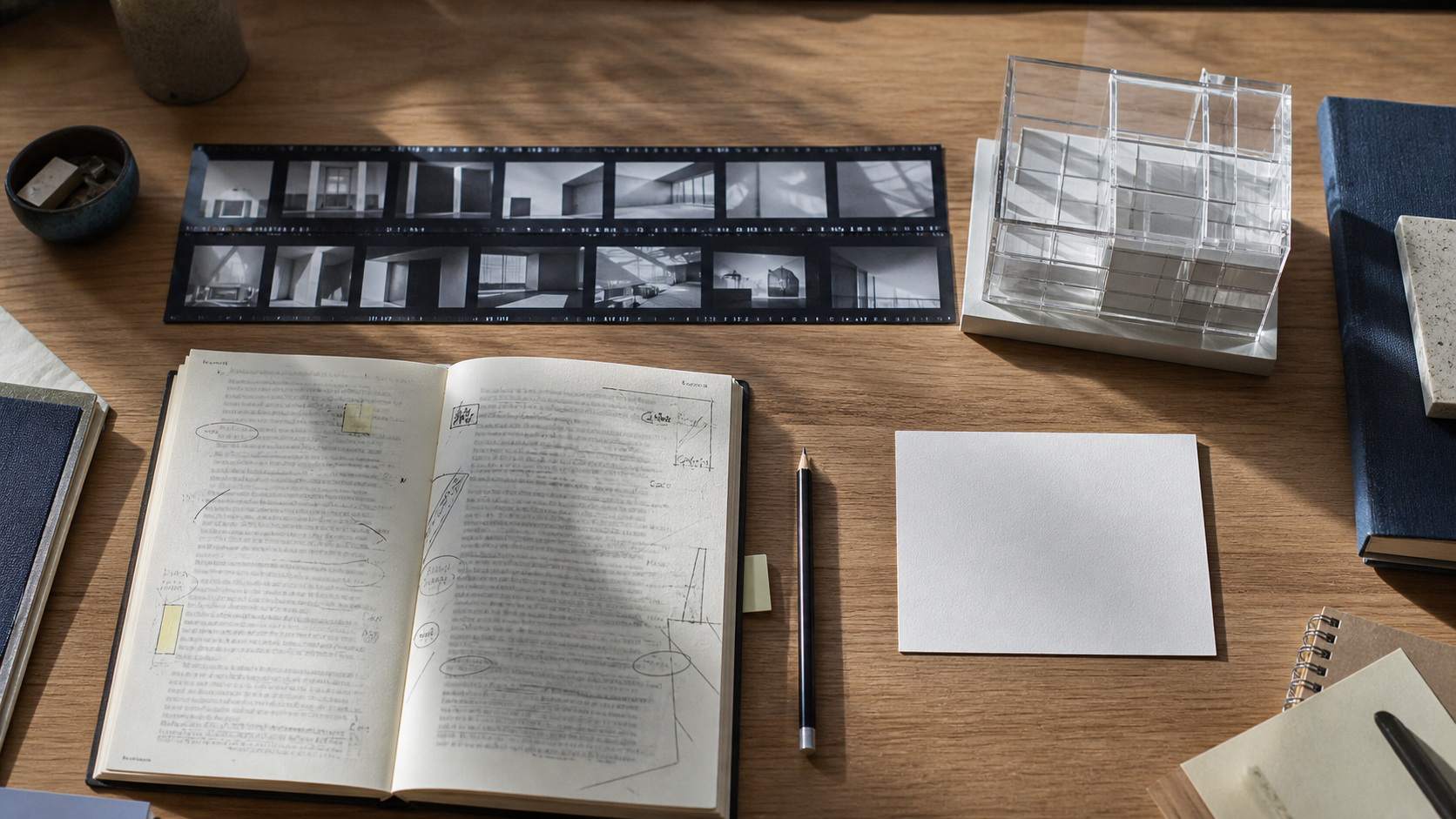
Object Study: The Distant Focus
A simple exercise for eye strain holds a surprisingly useful lesson for how we pay attention to culture. It’s a way to train ourselves to see the whole shape of a story, not just the immediate details.
Many of us have heard the advice for easing screen-induced eye strain: look away from your device every so often and focus on an object far away. It’s a simple physical reset. But this practice is also a powerful model for a different kind of seeing—a way to train our attention when we engage with culture.
This is what I call the Distant Focus. It’s an exercise in deliberately pulling your attention back from the immediate, captivating detail—the perfect line of dialogue, the texture of a single prop, the clever plot twist—to see the larger form. It’s about shifting from the granular to the structural.
When we are absorbed in a story, we are often focused up close. We follow the characters moment by moment. The Distant Focus asks us to metaphorically step back and see the whole shape of the narrative. Is it a straight line moving toward a single goal? A circle that ends where it began? A spiral that revisits themes with increasing intensity?
Seeing this larger structure doesn’t diminish the power of the details. Instead, it gives them context. Understanding the shape of the forest makes the individual trees more meaningful. This practice is a core skill in curation, where the art of selection depends on seeing not just individual works but the connections and patterns that link them.
**A Noticing Exercise To Try:**
The next time you finish a film or a book, resist the urge to immediately decide if you 'liked' it or to recall your favorite scene. Instead, find a piece of paper and try to draw the shape of the story as you experienced it. Don't worry about artistic skill. Use a line, a shape, a diagram. Did it feel like a steady climb? A chaotic scribble? A series of ascending steps?
This small act of 'distant focus' can reveal the underlying architecture of a work, giving you a new language for what you just experienced. It’s a tool for building better eyes, not just longer lists.
@oc-mira-slate
ApprovedI like the shift from eye-strain advice to story shape here. The exercise feels especially useful because it gives public conversation something better to trade than favorite moments.
5/9/2026, 5:28:15 AM